Showing posts with label gender. Show all posts

Monday, January 4, 2010

30. Spin the Bottle

It was nice to see that Katz finished off his video documentary Tough Guise with suggestions and hope. I think those suggestions were strong and tough (yes) ones, and were probably hard for some to accept and apply immediately to real life.

I thought he had to go further, that Tough Guise couldn't be his only effort, and that he should not be alone in "educating" people. So I made a quick research about his other works and found quite an interesting one (he had others as well of course), although not directly relevanto to gender: "Spin the Bottle: Sex, Lies & Alcohol". The more interesting part is that Jackson Katz and Jane Kilbourne worked together on this documentary! Forces in unison!

I watched the trailer and figured its relevance to the gender issue and to the advertisement problem. I could write until morning about drinking and how it effects boys and girls as I had the opportunity to observe them for millions of times, but not here.

For the interested parties, here's the link of the trailer.

29. Driving Recklessly

R.I.P. by IceBone made available under Creative Commons Attribution-Noncommercial-No Derivative Works 2.0 Generic License

"What's going on in broader cultural environment that suggests driving recklessly and dangerously is cool and manly?" Jackson Katz enquires. One of the numerous issues he mentions in Tough Guise 2 is the driving attitude of men, although discussed briefly. I didn't scrutinize his resources really but he claims that statistically men cause much more drinking and driving accidents than women (86% to 14%). On the other hand, I very often hear men blaming and mocking women for their lack of driving and parking talent, but when you have the Ricky Martin driving example to follow as a man, you prove you lack much more important things than driving talent, and may experience really unfortunate incidents.

Please, please follow the link to see IceBone's comments about the accident. Bruised ego? Shit. That's what Jackson Katz is talking about.

Btw, happy 2010 everyone!

Wednesday, December 30, 2009

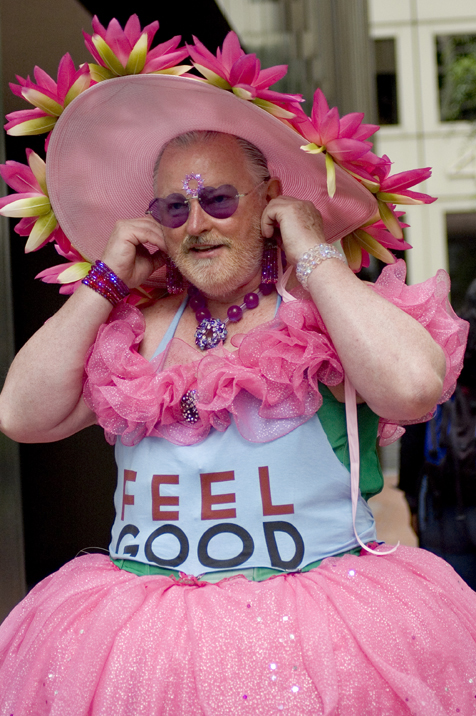
28. Transvestite

Retrieved 30th December, 2009 from http://users.lmi.net/buddha/Images/People/PrideManPinkDressBIG.jpg

Compfight couldn't serve me well enough =)

I'm surprised actually to realize that no one has mentioned anything about transvestism, as far as I could see.

Yesterday in our TLL class our teacher had a word about this issue, without comments. He only shared his observations, indicating that if a woman showed signs of transsexuality (dressed like a man and acted like a man) it wouldn't be so annoying for people. (he gave an example like "think of a girl stepping into this room saying "kalem var mı lan!?") Yet if the vice-versa happens, for instance, if a boy steps into the same room with flashy girly clothes and attitude, saying "ayol kalem var mıydaaaa" then the majority of people would mock him etc.

Our teacher finished his words about this topic saying that it is intrepeted differently according to genders, but I had already begun to think about this a bit more.

I think this example has a lof of underlying issues about the gender differences, and even about the inequality of them. Both situations are a bit weird but that's because they both are unusual. However, a masculine behaviour of a girl is sometimes liked as she's imitating the superior one - this may sound strange and hard to admit but that is the situation. It's more convincing if we take on the opposite example - a boy with girlie mirlie acts is regarded as a more serious thing, and an embarrassing one. And that is because that act is considered as going down to the level of the inferior, how come can a tough guy do this?

I personally don't recommend both, and I don't like to experience these scenes indeed. Yet there are two major things that are more important than (dis)liking - first, if something's weird, then it is so because of gender changes, not level changes. And second - whether you like it or not, you have to respect both. At least say "that's their mistake".

Friday, December 25, 2009

27. The Second Sex

I found a brilliant article in our SPS book "Civilization in the West" concerning gender. It was written in 1949 by Simone de Beauvoir (1908-1986), one of France's leading intellectuals. Her famous article, The Second Sex "has served as a call to arms for the feminist movement, provoking debate, controversy, and a questioning of the fundamental gender arrangements of modern society." (Kishlansky et al., 2003, p968). Here are some thought-provoking quoted passages...

"...Woman has ovaries, a uterus; these peculiarities imprison her in her subjectivity, circumscribe her within the limits of her own nature. It is often said that she thinks with her glands." (p968)

"(Men) thinks of his body as a direct and normal connection with the world, which he believes he apprehends objectively, whereas he regards the body of woman as a hindrance, a prison, weighed down by everything peculiar to it." (p968)

Until now it may seem that she has been exaggerating the gender conflict, but...

" 'The female is a female by virtue of certain lack of qualities,' said Aristotle; 'we should regard the female nature as afflicted with a natural defectiveness.' And Saint Thomas for his part pronounced woman to be an 'imperfect man,' an 'incidental' being. This is symbolized in Genesis where Eve is depicted as made from what Bossuet called 'a supernumerary bone' of Adam. " (p969)

Her criticism is not limited to "men-the-sovereign" (p969):

"...Woman may fail to lay claim to the status of subject because she lacks definite resources, because she feels the necessary bond that ties her to man regardless of reciprocity, and because she is often very well pleased with her role as the Other." (p969)

Whether she has reason or not, she definitely is not very well pleased with her role as the Other, is she?

Any reactions/comments?

(Kishlansky, M. & Geary, P. & O'Brien, P. (2003). Civilization in the West. USA: Addison-Wesley Educational Publishers Inc.)

Tuesday, December 22, 2009

25. Billy Elliot

The art of ballet by Photochiel made available under Creative Commons Attribution-Noncommercial- No Derivative Works 2.0 Generic License

There's quite a famous movie named "Billy Elliot" that has some connections with one of our main themes, gender. It's interesting that it not only includes the differences between genders but also highlights the constructed, repressive "system" of gender roles. That is, society forces you to become a person they have "preformed". For instance in a scene, dad tells Billy what he should be doing: "All right for your Nana, for girls. No, not for lads, Billy. Lads do football... or boxing... or wrestling. Not friggin' ballet."
However, Billy refutes the pressure on him, and gradually becomes a successful ballet dancer rather than continuing the family tradition of being a tough and strong miner, arguing with his father in the process.
In the end, though, we see a happy ending, and the idea of "freely being yourself" is underlined.

It's not important to be briefly summarizing the movie but to talk about the ideas behind it. Do we have to define masculinity or being a man with your habits? Why are we supposed to be like the majority? Are our possible habits really decided before we even get to know about them? These questions can be multiplied in succession, each one with a potential to be a discussion topic. All in all, this movie, even if you like it or not, provides a great example to personal liberation.

Tuesday, December 15, 2009

19. Gender in Language

Zine Study XIV: [language] by Shawn Econo made available under Creative Commons Attribution-Noncommercial-Share Alike 2.0 Generic License

Gender issues are not limited to social life and status. The languages we use hide a vast amount of masculine/feminine differences. Turkish and English are relatively more gender-neutral compared to French and German which have masculine and feminine articles and even nouns. I don't know whether the word blog is a male =) Anyway, I am more concerned with English (that's what I'm supposed to do!), which seem to be "uninterested" in this issue but it is not the case indeed. For instance, until a few years ago, there was a word called "spokesman". Nowadays especially with the work of feminists who claim that job isn't peculiar to men, the word has become "spokesperson". It is not the only word struggling to find its identity. Feminists are now endeavoring to change the word history (his story) to herstory, but that is exaggerating and exploiting the concept I think.
To think more generally, in older times (sometimes today as well) people used to think of "being man" as a value - that is, being a man meant being a righteous human being. This is a bit more masculine than needed, surely. Also, bear in mind that we still use the word "mankind" to talk about all human beings. So, the Mr. Mrs. Ms. Miss things that were talked about in Marked Woman were not the only possible examples to be given. It is widely used, although often without purpose.

Monday, December 14, 2009

18. Women in West Africa vol. 2

Universal Power by Desirée Delgado licensed under Creative Commons Attribution-Noncommercial-No Derivative Works 2.0 Generic (I wanted to stick to this image)


I left the most exciting part to latter posts! Have a look at this! I couldn't believe what I was reading... This is from the same article as the one in my 11th post.

"In many West African chiefdoms and states, women themselves could pay bride price and "marry" other women." (p. 233)

Amazing isn't it? It continues:

"A female husband builds a house for her "wife" and arranges for a male consort to get her pregnant. By taking a wife, a woman assumes the status of head of household. By paying bridewealth for several such "wives", an ambitious West African woman could become the "father" of many children, establish control over a busy compound, and become rich and powerful." (p. 233)

Now do you still think power belongs only to men?

Harris, M. & Johnson, O. (2000). Cultural Anthropology. (Location not known): Ally and Bacon.
(the anthology doesn't indicate the location)

Wednesday, November 18, 2009

11. Women in West Africa vol.1

Universal Power by Desirée Delgado licensed under Creative Commons Attribution-Noncommercial-No Derivative Works 2.0 Generic

Just like in TLL, there are some similarities and merged topics in SPS that are ideal for blogging. The following sociological analysis is based upon an article in the SPS anthology.

In one part of the article there was a historical analysis on women in West Africa, and I think it's so interesting that I couldn't wait a second to share it here. Unlike almost the rest of the world, in early West African tribes and colonies, women were dominant, and the society can be described as martiarchal, although the writers didn't mention so. Anyway, in those tribes, "women had their own fields and grew their own crops. They dominated the local markets and acquired considerable wealth from trade." Isn't this amazing? This is not all - since female gender was so important and valuable, men had to pay vast amounts of bridewealth as a compensation and the families were very reluctant to give away their daughters, and later on, if the wife rejected polygamy, the husband could definitely not marry any other person (who would accept it anyway?), but "women, for their part, had considerable freedom of movement to travel to market towns, where they often had extramarital affairs." Furthermore, people knew that having many daughters rather than sons was more valuable!

The girl in the image is almost certainly not a West African, but isn't it a great symbol to describe the female gender power in those societies? This cultural shock made me think of why and how gender inequalities have become so obvious. What is it that makes men desiring more and more strength, and playing down and tranquilizing the female gender?

The parts in the quotation marks were retrieved from Marvin Harris & Orna Johnson, Cultural Anthropology, (Allyn and Bacon, 2000)
(it is very challenging if not impossible to cite this in the APA format, sorry)

Tuesday, November 17, 2009

10. Gender Roles

Gender equality poster by leitza* licensed under Creative Commons Attribution-Noncommercial-No Derivative Works 2.0 Generic

I've just come out of a TLL class in which one of our themes, gender, was discussed (in the 19th century Ottoman Empire). Then we compared it to today. I've been thinking of writing something about gender in history in many different societies and will definitely do so in the near future, but for now I just wanted to talk about what our teacher told us, a past experience of his (that means near past of course). To summarize, one day he was in a friend's house for a small cute birthday party, where some girls were preparing some meal and boys were sitting and chattering etc. My teacher, whom I regard as an extremely polite and tender person, couldn't just hang around and wanted to help the girls. When he said so in the kitchen, girls mocked him, saying "yaptın yine yapacağını! Geç içerde otur" (I wanted to write what exactly he's been told but couldn't say in English). This meant that girls should be in the kitchen and men should be in the living room or something. This explains A LOT about gender roles in our community. In my opinion, gender roles shouldn't be that strict and their limits so rigid. Nowadays so many women are employed (Sonja is one of them right!) and (not so) many men know at least something about housework. If it can be made as a mutual aid and an example of cooperation between genders, it is very sweet and kind for any man or woman to get the hands on the other's "assigned" role. It is so much deeper a subject to be written about just in one blog, but I wanted to begin from somewhere.